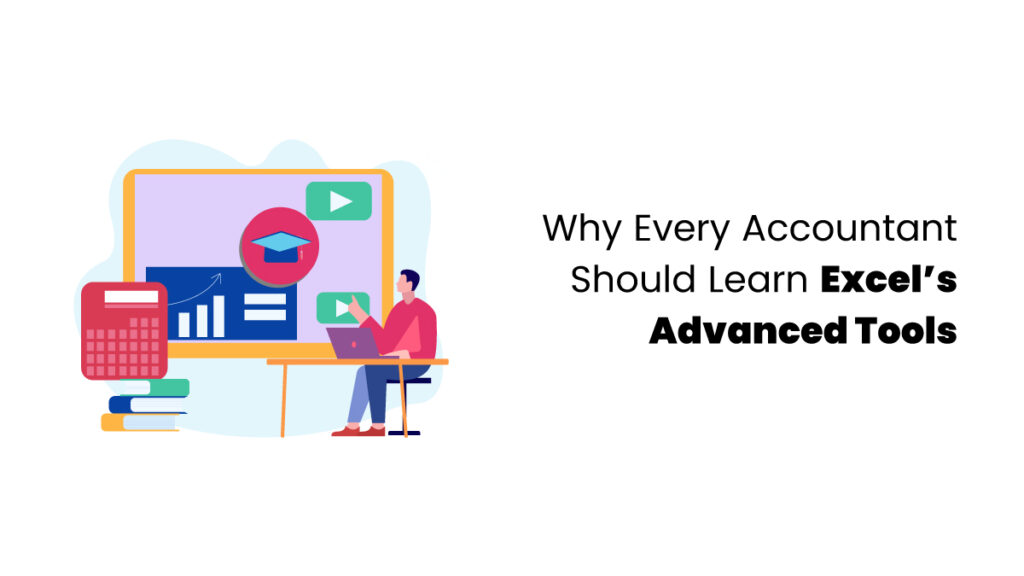
Why Every Accountant Should Learn Excel’s Advanced Tools
If there’s one tool that quietly powers most accounting work around the world, it’s Excel. From big firms crunching corporate financials to small businesses tracking expenses, Excel remains the trusted friend every accountant turns to. Yet, many professionals still use only a small slice of what it can really do. Knowing a few formulas or building simple spreadsheets is fine for beginners, but today’s world demands more. That’s why Excel for accountants is no longer about just entering data – it’s about mastering the advanced features that save time, improve accuracy, and unlock deeper insights.
This isn’t about learning software for the sake of it. It’s about gaining a skill that makes your daily work smoother, your reports smarter, and your professional life easier. Let’s unpack why every accountant should step up and learn Excel’s advanced tools.
1. The Power of Excel in Accounting
Ask any accountant what program they use most, and you’ll probably hear the same answer: Excel. It’s been around for decades, but it still reigns supreme because it’s practical, flexible, and endlessly adaptable. Whether you’re recording transactions, preparing financial statements, or analysing trends, Excel gives you full control over your data.
The beauty of Excel lies in its simplicity and its depth. You can start small and build up. But where many accountants stop at basic formulas like SUM or IF, the true potential begins beyond that. The more you explore Excel’s deeper features, the more you realise how much easier your life can be.
2. Why Basic Isn’t Enough Anymore
The accounting world has changed. Businesses run on data, and clients expect fast answers. Manual work and endless spreadsheets filled with copy-pasted numbers just don’t cut it anymore. Accountants are now analysts, strategists, and problem-solvers – Excel can help fill all those roles if you know how to use it right.
Let’s say you need to prepare a monthly expense summary for multiple departments. Doing that manually could take hours. But with PivotTables, filters, and formulas working together, you can generate the same report in minutes – automatically updated when new data is added. That’s the difference between “knowing Excel” and mastering it.
3. What “Advanced” Really Means
When people talk about “advanced Excel,” they often picture complicated formulas that only IT specialists understand. That’s not the point. Advanced means more effective, more reliable, and more insightful – the kind of spreadsheet work that reduces grunt tasks and increases the time you spend on analysis.
Examples of these capabilities include:
- Building PivotTables to summarise large transaction sets instantly.
- Using robust lookup methods like INDEX-MATCH to connect data safely.
- Cleaning and transforming messy exports with Power Query.
- Creating automated routines with macros or simple VBA.
- Designing dashboards to display key numbers clearly.
Developing advanced Excel skills is about learning to combine these features so your spreadsheets do the heavy lifting for you.
4. Daily Benefits You Can Feel Immediately
How does all this help you on a normal workday? In concrete ways:
- Less boring repetition. Automate routine tasks and free your time for interpretation.
- Fewer avoidable mistakes. Data validation, consistent formats, and structured tables reduce errors.
- Faster answers. PivotTables and dynamic formulas let you respond to questions in minutes, not hours.
- Cleaner audits. Well-structured workbooks are easier for auditors to follow and for you to defend.
- Clearer communication. Dashboards and charts help non-finance people instantly understand what the numbers mean.
Those wins add up. They make the accounting job less tedious and far more valuable to the business.
5. Career Payoff: Why Employers Notice
There’s a reason “Excel skills” is a staple on finance job postings. But the difference between a generic “knows Excel” and a candidate who can use Excel for accountants strategically is huge. Employers want people who can reduce cycle times, catch inconsistencies before they become problems, and produce analysis that helps managers act.
When you can automate reconciliations, build scenario models, and produce dashboards quickly, you become a reliable resource. That confidence and the time you free up for higher-level tasks often lead to promotions, better projects, and a stronger professional reputation.
Remember: tools don’t replace accountants, they amplify the ones who use them well. Investing in advanced Excel skills effectively future-proofs your role and opens doors to more analytical work.

6. Common Traps and How to Avoid Them
Even with the best intentions, it’s easy to fall back on old habits. Here are common traps and simple ways out:
- Trap: copy-pasting between files. Fix: use Power Query to import and refresh data reliably.
- Trap: tangled formulas that no one understands. Fix: use named ranges, comments, and clear layout to document logic.
- Trap: ignoring validation. Fix: apply drop-downs and rules to limit bad entries.
- Trap: one-off reports. Fix: build templates and parameterised models so results are repeatable.
Approach Excel like a craft. Clean work, consistent structure, and a little documentation make your future self and your colleagues grateful.
7. How to Get Started Without Getting Overwhelmed
If this sounds like a lot, breathe. The path is simple if you go step by step:
- Be solid on basics (formulas, relative vs absolute references, tables).
- Learn PivotTables first they pay off fast.
- Master lookup patterns (VLOOKUP, then INDEX-MATCH or XLOOKUP).
- Practice cleaning data with Text to Columns and TRIM, then graduate to Power Query.
- Try a small macro to automate a repetitive formatting job.
- Build one dashboard that tells a story revenue trends, major expense lines, and a key variance.
If you prefer guided learning, consider a focused classroom or online programme. For example, learners in Kerala sometimes look for a local MS Excel course in Kochi for structured, hands-on practice. Alternatively, a targeted advanced Excel course can give you a coherent path through the tools you’ll use most. Whichever route you choose, pair lessons with real work problems — that’s where learning sticks.
8. Practical Examples: Real Problems, Real Solutions
A few scenarios make the value obvious:
Month-end close: Instead of copying ledger extracts, set Power Query to refresh each source and push updated tables to a PivotTable report. A macro can export formatted PDFs automatically.
Budget vs actual: Use SUMIFS to accumulate departmental totals, then display differences in a small dashboard with conditional formatting that highlights material variances.
Vendor reconciliations: Use INDEX-MATCH to match invoices to payments even when columns aren’t aligned, and flag unmatched items for manual review.
These are everyday wins that make your workday less stressful and your output more defensible.
9. Why Excel Still Matters: The Bigger Picture
Even as companies adopt cloud accounting tools and BI platforms, Excel remains the lingua franca for finance. It’s the bridge between raw exports and polished analysis. Mastering Excel for accountants gives you the flexibility to integrate new tools later on Power BI, SQL, or scripting languages because you already understand how data should be organised and analysed.
Think of Excel as a toolkit: when you can weld the pieces together, queries, models, automation, and dashboards, you’re ready for whatever data challenge comes next. That adaptability is what keeps accountants central to strategic decision-making.
10. Keep Learning Small Habits, Big Gains
The most effective learning is incremental. Spend an hour or two each week on a new technique, and apply it the next day at work. Over months, you’ll stack skills that together transform your productivity.
Pair learning with action: take a real report you currently produce and rebuild it with better structure, fewer manual steps, and clearer visuals. Track how much time you save and what insights you uncover. That feedback loop keeps motivation high.
Final Thoughts
Accounting is about turning numbers into meaningful guidance. Excel is the tool that helps you do that elegantly. The difference between basic spreadsheet use and a well-crafted, automated workflow is the difference between keeping the lights on and moving a business forward. When you deliberately grow your capabilities, you not only make your job easier, but you also become the person who helps others understand what the numbers really mean.
So start small, focus on high-impact tools, and build from there. Learn to automate, model, and visualise with clarity. A few targeted improvements will change how you work — and how others see you. Mastering Excel for accountants is a practical, high-value investment in your daily life and your career.
Why Every Accountant Should Learn Excel’s Advanced Tools Read More »